Langmeier Backup Magazine
4.4 billion people live without the internet
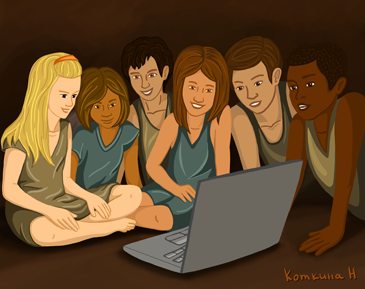
The majority of people live without Internet access. But developing countries are catching up.
The number of internet users worldwide grew again by almost seven percent in 2014, exceeding the three billion mark for the first time. This corresponds to around 40 percent of the world's population. This means that 60 percent of people are still excluded from using the internet, i.e. around 4.4 billion people. The International Telecommunication Union estimates that this figure will be reduced to less than three billion by 2020. However, there is little prospect for the approximately 2.5 billion inhabitants of the 42 poorest countries. Although islands with Internet access may emerge in some major cities over the next few years, the vast majority of people in these countries will remain excluded from the World Wide Web for a long time to come.
Developing countries are catching up
Apart from these very poor countries, however, it is clear that even less affluent regions of the world are capable of developing and maintaining a network infrastructure. The so-called "international bandwidth" serves as an indicator for this. This refers to the maximum bandwidth available in a country. In 2004, developing countries accounted for nine percent of international bandwidth; by 2014, this figure had risen to 30 percent. However, a little caution is required when interpreting this figure. It says nothing about how many inhabitants of the respective country can actually access this international bandwidth.
Censorship and surveillance on the rise
More and more countries are technically able to provide their citizens with free Internet access - but fewer and fewer countries want to! According to the World Wide Web Foundation, 84% of countries do not protect their citizens against indiscriminate mass surveillance via the internet, or do so inadequately. As recently as 2013, only 63% of countries were rated so negatively, meaning that spying on users has increased dramatically within the space of a year. This also applies to the censorship of internet content. In 2013, 32% of countries censored the internet; one year later, this figure had risen to 38%.
Reasons for the lack of protection against surveillance
For its analysis of online surveillance, the World Wide Web Foundation only analyzed the legal situation in the various countries. It is not clear from this analysis whether laws to protect privacy on the Internet are actually being observed or whether they are being undermined by domestic or foreign secret services, for example. To be more precise, the result should be formulated as follows: 84% of countries do not even attempt to protect their citizens sufficiently from mass surveillance through appropriate laws. One important reason for this is that more and more countries are expanding their surveillance options as part of the "war on terror". Some other states, which were never pioneers in terms of civil rights anyway, have closely followed the role played by the internet in the so-called "Arab Spring". In Egypt in particular, Mubarak's military government was visibly surprised and ultimately overrun by the resistance organized via Facebook. It was foreseeable that this would be closely observed by other dictators. As a result, the monitoring of social media and other communication platforms in particular has increased significantly worldwide. Incidentally, the technology required for this was often supplied by the Western operators of communication and data networks.


 Brochure